Posts categorized “Instructional”.

2. Significantly different: Content

On the student survey, we ask, “Was the content of your classes different from classes at your school?” We do not replicate the high school curriculum. We do not teach the Georgia Performance Standards or the Common Core. We provide our students with material that they will not encounter in a regular high school classroom.

Your class may be a college-level kind of course, or it might take students deeper into material to which they’ve already been introduced. You could do a broad introduction to a field, or delve deeply into a specific topic or work.

Some examples from years past:

  • Hap Truslow (SocStuds) brought photocopies of actual pension files of the New York Irish Brigade of the Union Army. Each student got his “own” soldier, and Hap guided them through decoding the documents in the file. The student had to evaluate whether the claim for a pension was justified based on their research into the Civil War battles the soldier (or his heirs) claimed he was in and the wounds he claimed to have received.
  • In Science (various instructors), the ecology students do field research using the various habitats here on campus, especially the creek. They learn to make specific and close observations and then set up experiments to answer questions they’ve developed.
  • Jobie Johnson (CommArts) guides students through Anglo-Saxon poetry, giving them the tools they need to pick apart the pagan basis from the Christian overlays.
  • Mike Funt (Theatre) works with masks and clowning to teach students how to use their bodies to express a storyline.

You have probably already talked to your department chair about what you want to cover in your class. If not, do so soon!

A good question is, “How different is too different?” We have to be able to afford whatever you’re teaching, of course; practical nuclear physics is probably not a good topic, and the budget certainly will not allow for a classroom set of the Riverside Shakespeare. Also, while our students are intellectually sophisticated, they are still minors. You have more latitude in addressing mature topics than you would back home, but remember that not just anything goes. My rule for that is if the topic is defensible, I will defend it. If you have questions about your plans, run them by me.

In comments, share ideas and questions you have about your instruction.
NEXT: Delivery and expectation of student response

3. Delivery and expectation of student response

On the student survey, we ask, “Was the way your teacher taught it different from your school?” While lecture is sometimes the most expedient way to get information into the students’ heads, we expect to see more than just lecture going on in GHP classes.

That is not to scare you away from lecture completely. Some of GHP’s finest courses have been lecture courses. But on the whole, the rubric to remember is that if you feel as if you’re working too hard, it’s probably because you are. Use delivery models that put the burden of learning on the student: discovery, read and response, abstraction/analysis/synthesis, etc.

As I observe you this summer, I do not necessarily need to see you standing and delivering. If I walk into your room and it looks as if you’re sitting in the corner doing nothing, that’s probably a good thing, as long as it’s obvious that the kids are deeply engaged and productive because of some switch you’ve flipped. One summer when I toured State School Superintendent Kathy Cox around the campus, in most of the classes we entered we didn’t see the teacher do anything. And it was fabulous.

We also ask the students, “Was the way the teacher(s) asked you to respond to it different?” and “Was what the teacher(s) expected you to do with it different?”

What does that mean? As an example, in a regular math class the student might be expected to learn a paradigm for solving a particular kind of problem, and then to practice that paradigm. At GHP, the student might be expected to develop a paradigm for solving a class of problems, or to be able to explain alternatives to the paradigm, or to create problems that would defeat the paradigm.

In music, rather than a goal of merely “getting all the notes right,” we could expect students to explore historically appropriate stylistic issues, or to be able to verbalize how their ensemble visualized a certain passage.

Ask yourself: when a student leaves my class, what should he be able to do that he wasn’t able to do before?

In comments, discuss things that you found to be clear or unclear about the differentiation of delivery and expectation of student response.

NEXT: Empowerment

15. Your evaluation: Instructional functions, part II

And finally, a simple list of questions that we will be using to evaluate your instructional design:

  • Is the material new, different? Is the strategy innovative? Are both appropriate?
  • How are students being challenged, stretched to think, perform, produce?
  • What knowledge is new? What skills are the students learning or practicing? What related behaviors are they expected to demonstrate? Have they been prepared to deal with the knowledge/skills/behavior?
  • What kind of interaction is visible? Who is interacting with whom?
  • Who is generating the task/learning activity? What is the type of learning activity? (Renzuli I, II, or III)
  • What is the general level of motivation, concentration, alacrity to perform/produce, perseverance, creativity, tolerance of ambiguity, of the students? (Habits of Mind)

NEXT: Odds & ends

14. Your evaluation: Instructional functions, part I

A word about observations. If you’re a first-timer, Marcie will set up a time with you sometime during the first week to come watch your class. She will observe for at least 30 minutes. You don’t have to stop what you’re doing when she comes in, nor do you have to acknowledge her when she leaves. (The same applies to Dale.)

She will try to get with you later to chat about what she saw. If she fails to do so, you can assume that she didn’t see any problems at all. (Conversely, do not assume, if we approach you, that we have issues with your teaching.)

She will be back to observe at least twice more during the summer. At least one of those observations she’ll ask you to tell her a good time to come. Other times she may just pop in. She is not trying to “catch” you doing anything except a good job.

Do not worry that it looks like you’re not doing anything. As long as the students are actively engaged, participating, and producing, you’re teaching.

In other words, relax about the observation/assessment thing.

Today’s criteria have to do with classroom management.


What is the class activity/student task?

An observer should be able to discern what’s going on, or at least that something is going on.


Who is doing the talking? the listening? the analyzing? the decision making? the problem solving? In what balance?

Especially as the class progresses, we really need to see more and more student activity compared to the amount that you’re center stage. We should also see a balance among the students: there shouldn’t be a “smart kid” problem.


What materials/equipment is being used and how?

Let us not see worksheets, please. Hide them or something. (N.B.: handouts are not worksheets. You probably should be handing those out.)

Are the students engaged directly with the material, or are they having to go through you to get it?

If your classroom is a smart room, are you able to incorporate that effectively?


What posture are the students in? Where is the teacher? Is every student actively engaged?

No sleeping! You also want to check for “boredom” postures. If there’s resistance to the material, figure out why. Is it the one kid, or is it all of them?

Are you actively monitoring student response, or are you hiding in the work?


How is the learning environment arranged?

This is more important than you might think. Every summer, VSU’s staff moves literal mountains of furniture for us so that your classroom is set up for maximum flexibility. Make sure you use that flexibility appropriately. (Science labs are less flexible, to be sure.)

If you’re lecturing, students need to be facing you. If you’re having a class discussion, you all need to be in a circle so everyone can see each other. Small group work in small groups. Panel discussion: small group up front, everyone else facing them.

If you have a larger room and you need interactivity between the students, don’t let them spread out. Bunch them, preferably up close to you.


What role is the instructor taking, e.g., lecturer, demonstrator, resource person, facilitator, etc.?

All of these are valid, and you should have realized by now that you will want to be open to all of them.


From what source is the information coming?

Vid. sup., how close are kids to the primary source? Renzulli I activities may require you to do a lot of shoveling, but our goal at GHP is to move out of that phase as quickly as possible.

NEXT: Your evaluation: Instructional functions, part II

12. Evaluation without artifacts, part II

Here are some more ways to measure progress in your class without testing.


Behavior change

If you have a student who is not participating, engaged, or productive, then start pushing for behavior change and measure that.

You can measure overt behavior: does he now shut up and listen to others in the group? Is he more orderly in his productivity?

You can measure intellectual behavior as well: has he improved in his ability to argue a point? Has he ratcheted up his level of response to the material?

It is perfectly fine to make your goals for a student explicit to him. “I’ve noticed that you hang back when we’re discussing the essay. What’s up with that? What can we do to get you more comfortable jumping in?”


Habits of Mind

Robert Marzano, in his Dimensions of Learning, proposed “Habits of Mind” as the fifth dimension/area. These are behaviors of a mature, metacognitive learner, and we certainly should expect our students to be able to be outstanding in all the criteria Marzano developed.

There are thirteen of these criteria, and they include things like tolerating ambiguity, being aware of and sensitive to other’s level of learning, being accurate and seeing accuracy, setting one’s own standards, etc.

We strongly urge you to look through the following links:


Feedback

Finally, if you really want to know how the class is going, ask. Have a discussion at the end of the week about how things went. Do a survey. Have them write in their journals. Ask them if it was challenging, engaging, interesting. Listen, and respond accordingly.

By the end of the first week, you ought to have seen enough of these indicators to know whether each student is working appropriately and whether your instruction is hitting the mark. If you see anything wrong, it’s time to intervene. Do not wait until the fourth week to come to me and complain about a student “not doing any of the work”!

If you are in a department that rotates kids, make sure you share your observations about problem students with the others in your department so that everyone can bear down on the problem.

Next up, what we do to evaluate you!

11. Evaluation without artifacts, part I

We don’t do tests or grades at GHP—students receive no formal evaluaton or credit for their participation in the program. So how do we tell if we—and they—are doing a good job?


Participation

First, check for participation. Is the student actually participating in class? Are all the students participating in class? (We might as well say at this point that we are all sleep deprived by week 4, but no one sleeps during class time.)

Does the student bring things to the group? Does he follow up on other people’s comments? Does he read the passage you’ve assigned? Does he jump into the discussion?

Is the kid participating in the program as a whole? Does he go to seminars, to concerts?


Engagement

Is the kid engaged with the material? With his peers? With you and other adults? Is he engaged with the program?

There is a difference between participation and engagement. A student can participate but not be engaged at all.

Here’s Dale’s classic example:

I was observing a theatre class one morning, and they were doing one of those circle exercises, where a kid in the middle was performing some repetitive action. Everyone in the circle was mirroring the motion. Eventually the person in the middle would go over to another student in the circle, “transferring” the motion to the new person, who would move into the circle. The new person would modify the motion somehow, and the process would continue.

One young man attracted my attention. He was certainly participating: he was doing all the motions and paying enough attention to mirror the motion when it changed. But he was in no way engaged. His whole demeanor said, “My teacher told me to come because it would look good on my resumé, but since they don’t do ‘real plays,’ I won’t learn anything.” And he wasn’t learning anything. Watch out for the non-engaged.

Conversely, you may have a student who is intently engaged, just devouring your class and the program as a whole, but isn’t participating in class. You have to watch out for these “quiet ones” as well and help them find a way to jump into the pool with everyone else.


Productivity

Is the kid producing? Is he actually doing the work: reading, writing, finding data, warming up, finishing assignments, taking risks?

Believe it or not, we actually will have kids who decide that since there’s not a grade hanging over their head, they don’t have to do any work. If this kid is in your class, speak to him right friendly in his ear, and if that doesn’t work, call Marcie in. We’ll rough him up a bit explain to him how GHP works and his role in it, and if he still doesn’t “participate fully in the program,” as his handbook says, we’ll send him home. (Usually with this kind of kid there are other programmatic issues as well.)

Participation—engagement—productivity. Look for these three markers, and look for them assiduously the first week. They are your best indicators of how well the students are coping with the program.

In our next post, we”ll discuss a few factors which indicate how well your carefully designed instruction is going.

8. Goals: further thoughts

As you work on your instructional goals, here are some things to keep in mind.

Make them realistic in terms of time and materials. Don’t plan on your students reading huge thick books or spending hours after majors on your class. Remember that GHP is more than what goes on in your classroom plus students have their minors plus students have their summer AP reading plus they have to eat and sleep sometime.

Also, realistic is not the same as achievable, which your goals do not necessarily have to be. In fact, achievable may be setting your goals too low! There’s that fine line between inspiring and frustrating: find it and make it your home.

In fact, this is a good time to talk about failure. One huge gift you can give your students is the opportunity to fail safely. Celebrate mistakes—celebrate crashing and burning! Remind them over and over: there are no grades, why not just take the chance? Audition for the dance minor, take the NaNoWriMo class, pick a project topic you know nothing about.

With that in mind, in developing your goals, your expectations need to be high. Assume that what you want them to do, they can do. Remember, above all, that you don’t have to know it for them to learn it. It is perfectly OK for you to explore and learn alongside them. Indeed, in Phase III activities, we hope at least some of your kids leave you in the dust—and so should you!

And then motivate them to do it. “Ad hoc” empowerment, safe failure zone, your dazzling instructional framework: use it all to maximize your agenda.

If for some reason things are not working out, you have several resources. Your fellow department members, your department chair, and us (i.e., Marcie and Dale)—in that order!. That is part of our job, to make this a safe failure zone for you. Remember we’ve been here forever; we’ve probably seen your problem before and might even have a solution at hand. So track us down in the dining hall or poke your head into Marcie’s apartment . That’s what she’s there for.

NEXT: 9. The nature of the beast, part I

7. Instructional goals

If you work in the Georgia public schools, you are probably required to post your standards and your instructional goals on the board. We don’t do that at GHP, of course, but it is nonetheless a good idea for you to formulate explicit, written instructional goals for design purposes.

Couch them in terms of the knowledge, skills, and behaviors that you want the students to leave with.

As you design your class, if it all seems fuzzy (“…and then a miracle happens”…) try this: On one side of a sheet of paper, write When you finish this activity/lesson/unit/class, you will

  1. have a better understanding of…
  2. be able to…
  3. apply…

Complete the sentences as if you’re talking to the students as you begin the unit.

On the other side of the paper, write We will know you are making progress toward meeting this goal when you… List 1-5 evidences that span whatever cognitive hierarchy you like to work with.

You can see how this little exercise would clarify your thoughts on the matter. (Remember the quote, “There is nothing quite like facing the hangman’s noose to focus one’s mind.”)

As we go through the summer, Marcie (and Dale) will be observing your class. It will help you alert us to what we’re seeing if you already have in your head the framework of what’s “supposed” to be going on. Also, at the end of the summer, you’ll get a form to evaluate yourself, and the first thing it asks you is what your instructional goals were. Go ahead and write them now.

Can you change your goals? Absolutely. You don’t know what you’re getting into—you really don’t; none of us did—and more than likely you’ll start making adjustments at lunch on Monday. That’s not only acceptable, that’s good teaching.

NEXT: 8. Goals: further thoughts

6. Renzulli: Application & example

How has Renzulli’s three-phase model of learning activities been put into practice at GHP? We’ll look at the art department and the math department, both of which have structured the overall summer along these lines. [N.B.: These examples are from the past when the program was six weeks long. Adjust your expectations accordingly. —Dale, 2011]

Phase I: Teacher as director

The art department spends the first two weeks cycling the students through the various media being offered for the summer: painting, ceramics, drawing, 3-D, etc. In each, the student is given a basic assignment, such as painting a still life, creating a teapot (must have a handle, a lid, and a spout; need not contain water), and so forth. Throughout, teachers give direct instruction on techniques the students need in order to perform the assignment.

The math department moves its students through several research projects independently of the classes it offers. The first one is a “scavenger hunt” activity, designed to introduce students to the resources of the library and the internet, as well as the various areas of mathematics.

In both departments, the notion of “ad hoc” empowerment is first and foremost at this stage.

Phase II: Teacher as facilitator

Next, the art department brings in guest artists and has them demonstrate “how they do it” for the students. Then the students are invited to replicate those strategies and techniques, experimenting with them and either incorporating or rejecting them in their own work. Here we see the replication of models at work.

The math department gives its students a menu of topics to choose from and asks them to explore one of them. Once again, the teacher sets the problem, but the student devises the solution.

Phase III: Teacher as mentor

Finally, art majors are asked to propose a series of work they’d like to work on. It might be an exploration of a particular medium, or subject, or strategy. For example, a student several years ago did a whole series of mixed media works on household appliances. At this point, the teachers just sit back and observe, and the kids know they can ask for assistance on any problem they’re having, either technical or artistic.

In the math department, students must find a final research topic that interests them from the broad fields they’ve been exposed to. It might be an actual math problem to develop, or some historical or technical topic to explain. The math teachers, again, serve as backup when students hit dead ends.

These two departments use the Renzulli model as an overarching structure for the entire summer, art as the basis for their whole program, math for one strand of theirs. You can see how the structure might apply to your coursework, whether to a one week course in social studies or a brief lab unit in science.

Perhaps others can share how they’ve implemented it in their GHP classes.

NEXT: 7. Instructional goals

5. The Renzulli model

The following is based on the research and ideas of Joseph Renzulli.

Renzulli proposes a three-phase model in empowering students as learners.

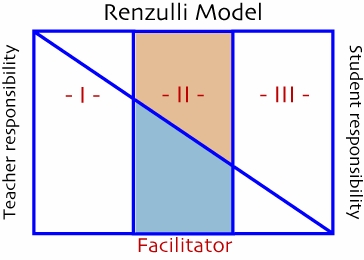
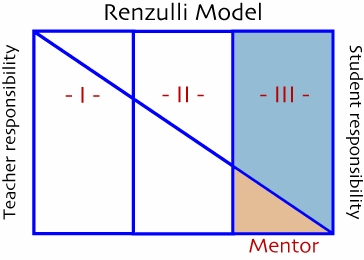
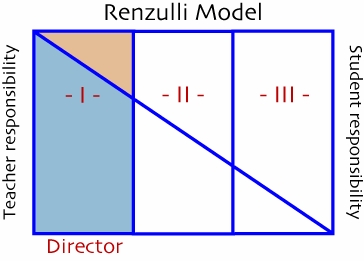
As shown in the following charts, the responsiblity of the teacher for the learning activity decreases as the student’s increases.


renzuli-graphic-i

In Phase I activities, the teacher serves as the director. The teacher sets up the problem and the path(s) to the (generally) predetermined solution. This is the “ad hoc” empowerment phase, the frontloading phase. It is here that lecture as a delivery model would be most appropriate.


In Phase II activities, the teacher serves as the facilitator. The teacher sets up the problem, but solutions and the structures for those solutions are more the student’s responsibility. The teacher helps the student manage the information and its outcome. Often, Phase II consists of replicating classic models in the subject area.


In Phase III activities, the teacher sits back and plays the mentor. The student defines both the problem and the solution. The teacher is there only to provide guidance when the student needs it.

It should be pretty clear that Phase III is where we want students at GHP to be operating. However, while our kids certainly have all the potential for Phase III, we sometimes dump them there without making sure they’re ready. Phase I activities at GHP may last five minutes instead of a semester, but don’t make the mistake of thinking they’re unnecessary.

In our next post, we’ll look at the application and examples of this model at GHP.