The following is based on the research and ideas of Joseph Renzulli.
Renzulli proposes a three-phase model in empowering students as learners.
As shown in the following charts, the responsiblity of the teacher for the learning activity decreases as the student’s increases.
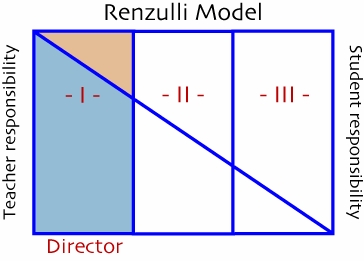
In Phase I activities, the teacher serves as the director. The teacher sets up the problem and the path(s) to the (generally) predetermined solution. This is the “ad hoc” empowerment phase, the frontloading phase. It is here that lecture as a delivery model would be most appropriate.
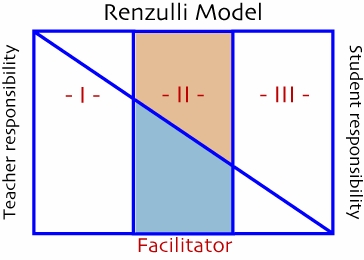
In Phase II activities, the teacher serves as the facilitator. The teacher sets up the problem, but solutions and the structures for those solutions are more the student’s responsibility. The teacher helps the student manage the information and its outcome. Often, Phase II consists of replicating classic models in the subject area.
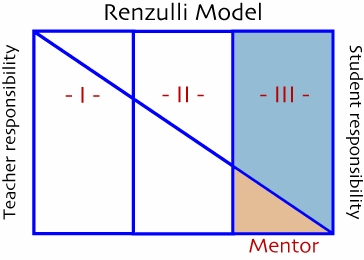
In Phase III activities, the teacher sits back and plays the mentor. The student defines both the problem and the solution. The teacher is there only to provide guidance when the student needs it.
It should be pretty clear that Phase III is where we want students at GHP to be operating. However, while our kids certainly have all the potential for Phase III, we sometimes dump them there without making sure they’re ready. Phase I activities at GHP may last five minutes instead of a semester, but don’t make the mistake of thinking they’re unnecessary.
In our next post, we’ll look at the application and examples of this model at GHP.
I was introduced to Renzulli when I first began teaching at GHP. I struggled at first, but it eventually helped me change the way I thought about teaching social studies in the regular high school.
Posted by Ben Crosby on May 15th, 2013.
Director, Facilitator, Mentor this is the process. I used this in my classes before I knew it was a model for teaching. This is the way I learned best as a student and I copied the process from my begining as a teacher. It works. Some times a teacher will have to spend more time in one process than another, but it works.
Posted by Suzie Click on May 15th, 2013.
Hmmmm yes, I used this in my teaching as well. I’d like to point out that, in general, if a student can do well in the latter two phases, they tend to not really need much directing other than setting the scope.
Posted by Henry Mei on May 15th, 2013.
I love teaching as a mentor instead of a director. The students enjoy controlling their own learning and I enjoy not being in the spotlight the entire time.
Posted by Vance on May 19th, 2013.
With Comm. Arts classes changing every week, it can be challenging to get into Phase III, but I will continue to push myself to find ways to move beyond even the classic GHP roundtable discussions.
Posted by Daniel Glenn on May 20th, 2013.
Daniel- the CA concern is noted; it seems difficult to move through this entire process in just one week of seat time. However, you will notice that even with switching curriculum every week, the kids begin to operate more independently as the month moves on. The Supreme Court class you offer in week one will have significantly more problem exploration when you offer it in week four. The kids pick up on the process of facilitating their own learning- it’s not that they pick it up discretely for one class or subject.
Posted by Jobie on May 20th, 2013.
We have learned through experience that this is, without question, the best recipe for success: “It should be pretty clear that Phase III is where we want students at GHP to be operating. However, while our kids certainly have all the potential for Phase III, we sometimes dump them there without making sure they’re ready. Phase I activities at GHP may last five minutes instead of a semester, but don’t make the mistake of thinking they’re unnecessary.”
Posted by Gini on May 21st, 2013.
Got it
Posted by James d on June 7th, 2013.
Such a great model in terms of empowering the students for their own learning…
Posted by Catherine Muller on June 9th, 2013.
Direct their learning by introducing them to creek ecology; facilitate their learning in the field; mentor their individual investigations of their findings.
Posted by Rebecca Potter on June 9th, 2013.
I think this will be the crux of my first summer teaching at GHP.
Posted by Jordan on June 17th, 2013.
got it
Posted by Hugh on June 24th, 2013.